
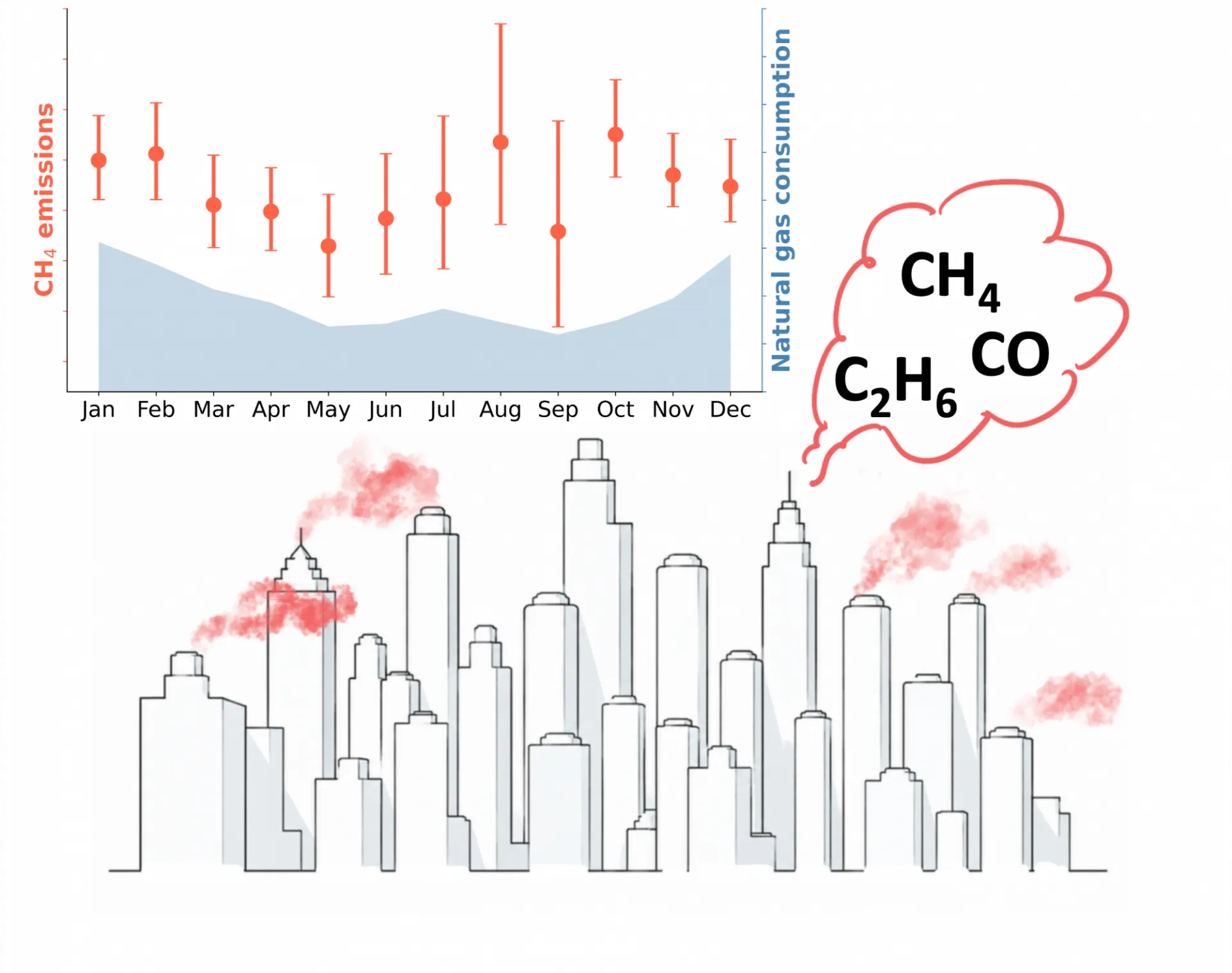
Yuwei Zhao’s paper, Inefficient Consumption of Natural Gas Drives Methane Emissions from A Megacity, published in Atmospheric Chemistry and Physics, focuses on city-scale methane emissions from the New York City Metropolitan Area. The study points to natural gas consumption as a significant driver of methane emissions from New York City, with a natural gas loss rate of 1.7%, equivalent to about $300 million worth of unused natural gas paid by consumers each year. Rebecca Fowler wrote a great press release about this research, and the study received media attention from Earth.com and WNYC.
Thank…
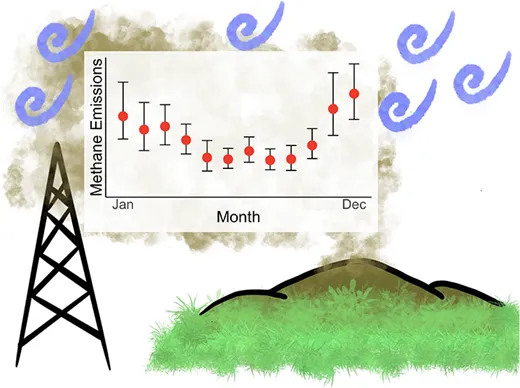
Hallward-Driemeier, A., Zhao, Y., Drews, M., Sargent, M., Wofsy, S., Barton-Grimley, R., Yerasi, A., Collins, J., Nehrir, A., and Commane, R.: Seasonal Landfill Methane Emissions Driven by Temperature and Pressure, Environ. Sci. Technol., https://doi.org/10.1021/acs.est.5c16757, 2026.
Dandan Wei's ES&T paper: High-Resolution Modeling of Summertime Biogenic Isoprene Emissions in New York City received a lot of interest from NYC news! Kevin Krajick at LDEO wrote a press release that interested many media outlets, some of which wasn't quite what we intended. But thankfully, Austyn Gaffney interviewed Dandan, Andrew Reinmann and Roisin for a really well written article in the New York Times: New York City's Trees Work Hard. Still, they could use a little help that explained the link between biogenic volatile organic compounds…

Oaks and sweetgums, which currently account for a majority of New York City’s trees, produce huge amounts of volatile compounds called isoprenes. Harmless by themselves, isoprenes interact rapidly with polluting nitrogen oxides emitted from combustion (by vehicles, buildings and industry) to form ground-level ozone―a prime factor in many respiratory ailments, especially chronic bronchitis and asthma.
A new peer-reviewed article evaluates a first-of-its-kind pilot project to study the effects of residential cooking electrification (gas-to-induction) in a public housing setting in the U.S. Results suggest the effectiveness of electric stoves as a means to reduce nitrogen dioxide (NO2) exposure in the home with households that replaced their gas stove for an induction stove registering a 56% drop in NO2 concentrations compared to households that still had gas stoves. Participants also unanimously reported satisfaction with their induction stoves and cited significant quality of life…

Yuwei attended the 2024 Summer School for Inverse Modeling of Greenhouse Gases, Fort Collins, CO, June 2024

The group attended three workshops in Boulder, CO over the space of two weeks in May to present on our Arctic and urban work.

Congratulations to Dr Ludda Ludwig on brilliantly defending her PhD dissertation. Ludda was an amazing student to work with over the last 4.5 years! While we are sorry to lose her, we are delighted that she has taken a position at the US EPA to focus on methane. Best wishes for the future Dr. Ludwig!!
Roisin gave the April Public Lecture at Lamont Doherty Earth Observatory:
Clearing the Air: Understanding New York City's Air Quality and Climate
Thanks to all who joined in person. The lecture was recorded and is available on Lamont's YouTube channel alongside all the previous Lectures:
https://www.youtube.com/watch?v=qtMcAQVOvUk
Many of the group presented at the American Geophysical Union (AGU) Fall meeting in San Francisco, CA in December 2023.